From Burnout to Buy-Out-Ready: The Operations Shifts That Turn a Solo Practice into a Scalable Company
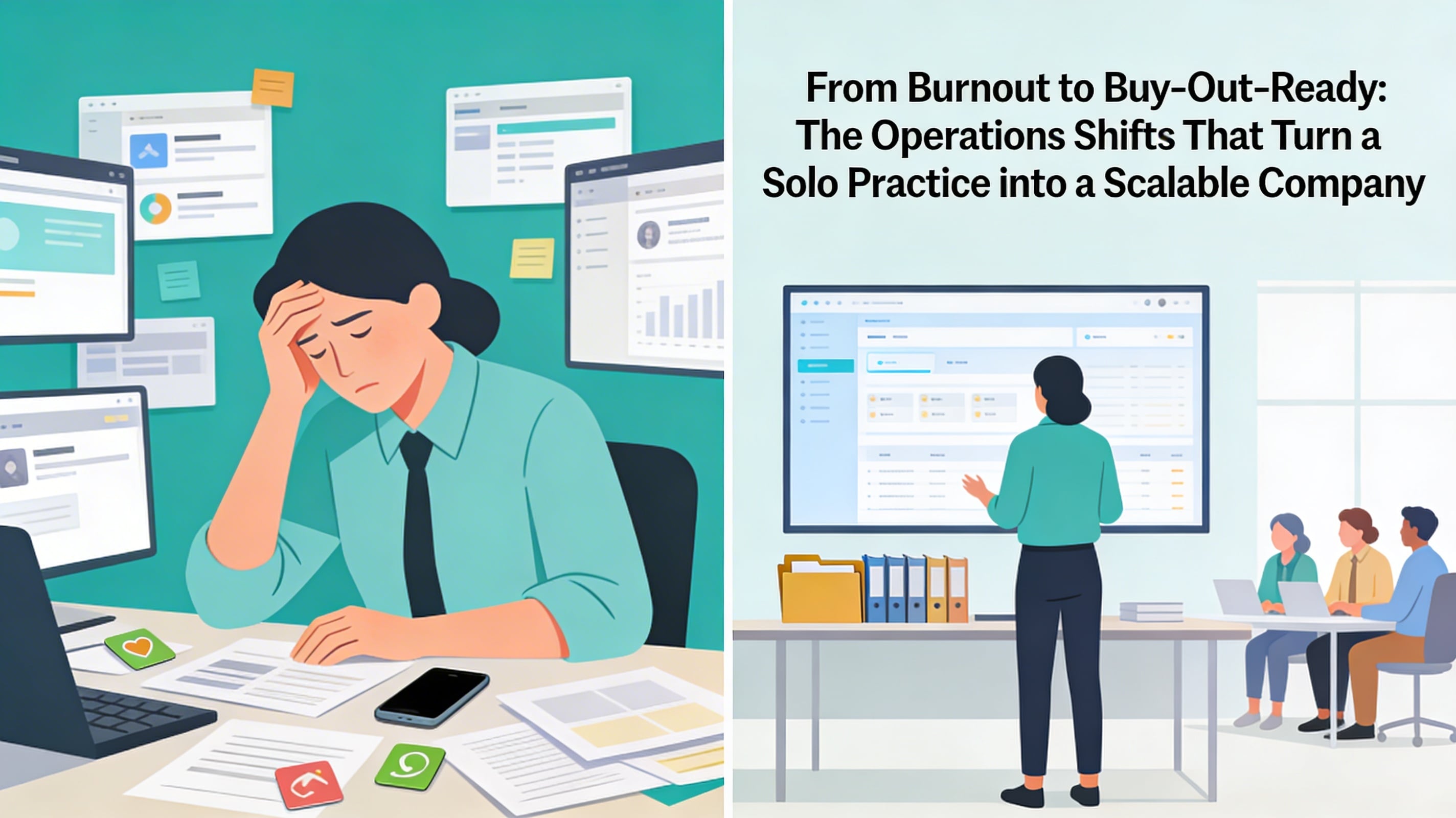
If stepping away from your business for even a long weekend feels impossible, you’re not alone. Many service providers and coaches accidentally build a job around themselves instead of a company that can run, grow, and eventually be sold without them. The good news: the same operational shifts that reduce burnout also make your business far more “buy-out-ready” and valuable.
In this blog, I’ll walk you through five key shifts that move you from being the overextended hero of your business to being the CEO of a scalable company.
What “Buy-Out-Ready” Actually Means (Even If You Never Sell)
“Buy-out-ready” doesn’t mean you’re putting your business on the market tomorrow. It means you could. A buy-out-ready business has:
- Clean, organized financials and documentation that are easy for others to understand.
- Standardized systems and processes so operations don’t live only in the owner’s head.
- A business model and team structure that isn’t dependent on one person to function day to day.
Buyers, investors, and even lenders look for businesses that are stable, predictable, and not overly reliant on the founder. When you build your business that way, you also get something you probably want right now: time back, mental space, and options.
Shift #1: From Hero Mode to System-Dependent
Burnout thrives in “hero mode”. When everything depends on you remembering, deciding, and doing, your brain becomes the project management tool, the SOP library, and the emergency hotline.
To become buy-out-ready, your business needs to run on systems, not memory. That looks like:
- Documented, repeatable workflows for core functions: lead intake, sales calls, client onboarding, delivery, offboarding, renewals, and simple reporting.
- Clear checklists and templates that anyone on your team can follow.
- A central place (like ClickUp or your preferred PM tool) where tasks, timelines, and responsibilities live.
From an exit-readiness perspective, documented processes and an operations manual are non-negotiable. They allow a future buyer (or future team) to see how the business operates and replicate success without you.
From an anti-burnout perspective, they mean: fewer decisions, fewer emergencies, and fewer dropped balls.
Shift #2: From Reactive Tasks to a Designed Client Journey
Many solo practices operate in a constant state of reaction: answer that email, fix that tech issue, squeeze in that client who “just has a quick question.” There’s no consistent, designed experience, just a lot of putting out fires.
A scalable, buy-out-ready business has a clearly mapped client journey, for example:
- Lead discovers you and opts into a simple next step.
- Discovery call or application with a standard process and criteria.
- Onboarding with automated emails, forms, and expectations.
- Delivery milestones that are time-bound and visible to your team.
- Offboarding and renewal/upsell pathways.
When you define and standardize that journey, you can:
- Improve client satisfaction and retention because the experience is consistent and professional.
- Track key metrics like conversion rates, churn, and client lifetime value.
- Give a buyer confidence that future revenue isn’t random or founder-dependent.
You’ll feel less frantic because you aren’t reinventing the wheel with every new client.
Shift #3: From Messy Money to Decision-Ready Numbers
Nothing spikes stress like uncertain money. Many small business owners have income, but not insight. They’re making gut-based decisions because the numbers are confusing, scattered, or out of date.
A buy-out-ready business has:
- Up-to-date bookkeeping in proper accounting software (not just a patchwork of spreadsheets).
- Clean, reconciled financial statements for at least the past few years.
- Clear separation between business and personal expenses.
- Basic dashboards that track revenue, profit, cash flow, and key operational metrics.
Why it matters for a future sale: buyers look at the quality of your financial records first. If the numbers are messy or inconsistent, valuation drops and deals derail. Why it matters for burnout: when you know exactly what’s coming in, going out, and what you can afford to invest or outsource, you make calmer, more confident decisions.
Shift #4: From Lone Wolf to Scalable Team
If you still believe “it’s faster if I do it myself,” you’re capping your growth and your resilience. A business that can’t function without you is very hard to sell, and very easy to burn out in.
Scaling from solo to company doesn’t mean hiring a huge team overnight. It often starts with:
- A virtual assistant to handle recurring admin, scheduling, and client communication.
- A tech or operations assistant to manage tools, automations, and basic reporting.
- A client success or delivery partner to help implement parts of your core service.
The difference in a buy-out-ready business is that each role is supported by defined responsibilities, documented processes, and some level of cross-training. That makes the business more resilient and less risky in the eyes of a buyer.
For you, it means you’re no longer the bottleneck. You’re the leader!
Shift #5: From Short-Term Hustle to Exit-Minded Planning
Most founders start their business to create freedom, not to think about an eventual exit. But operating with an “exit lens” changes how you make decisions today.
Exit-minded planning for a small service business includes:
- Clarifying what you actually want long-term: sell, keep and step back, or eventually wind down.
- Reducing owner dependency by gradually delegating operations and client delivery.
- Avoiding over-reliance on one or two key clients or platforms.
- Standardizing and packaging your offers so they’re easier to deliver and easier for others to sell.
- Giving yourself 18–24 months to make these changes, not trying to scramble in six.
This doesn’t lock you into selling. It simply creates options: the option to sell, the option to step back, the option to take a real sabbatical without your business collapsing.
How Fractional Operations Support Fits In
Most founders don’t want to become operations experts, and they shouldn’t have to. That’s where a fractional Director of Operations or COO-style partner comes in.
A fractional operations partner can:
- Audit your current operations, systems, and financial visibility to identify the biggest risks and opportunities.
- Design a prioritized roadmap to move from “founder-dependent” to “system- and team-dependent.”
- Implement the right tools, automations, and processes so your back office runs smoothly.
- Help build the management structure and reporting cadence that buyers and investors look for.
You get senior-level strategic guidance and implementation support without the cost or commitment of a full-time executive, which is exactly why fractional executives are increasingly used to prepare companies for funding, M&A, or sale.
From Burnout to Buy-Out-Ready: Your Next Step
If you recognize yourself in the burnout side of this article: overbooked, over-relied-on, and secretly wondering how long you can keep this up; your first step isn’t to dream about a distant sale. It’s to stabilize your operations now, in a way that also increases future business value.
I partner with visionary service-based business owners to design and implement the systems, metrics, and team structure that turn a solo practice into a scalable, buy-out-ready company.
If you’d like help diagnosing where you are on that journey and what to fix first, your next step is simple: book a brief Discover Call so we can identify your top two or three leverage points and start moving you out of burnout and into leadership.